
Design System Goals
Define why your design system exists and what it should change
Turn scattered assumptions into an evidence-backed Goals Record with clear outcomes, priorities, constraints, and non-goals for your team and AI tools
Trusted by designers from
Design system work gets messy when goals remain implicit. Teams know what to build, but not why it matters or where to stop
_
Everything you need to define, validate, and share your design system goals
Move from scattered assumptions to a clear Goals Record with structured decisions, AI support, and team-ready guidance
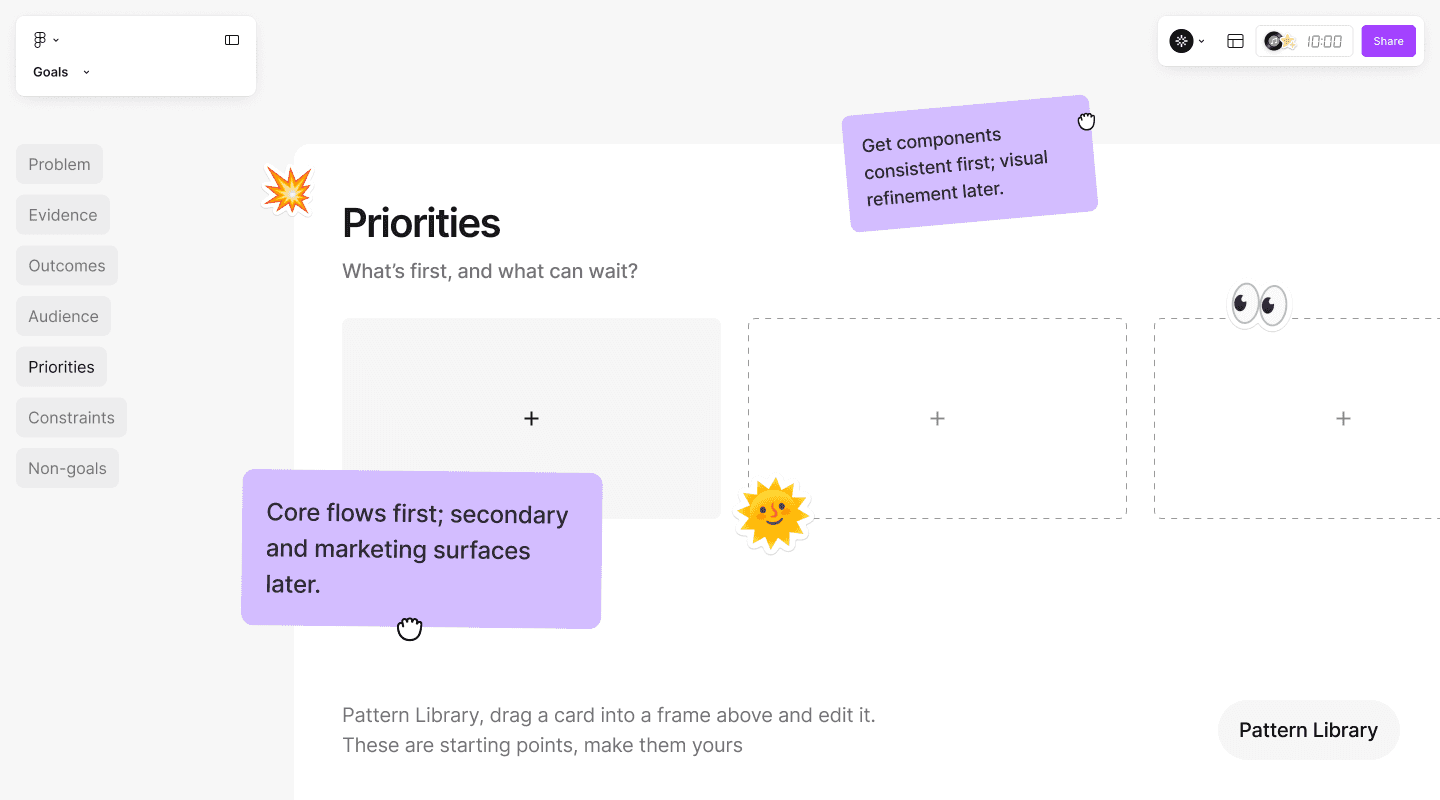


FigJam board
fig
Define seven connected decisions using a guided FigJam board and ready-to-adapt pattern library cards for faster progress
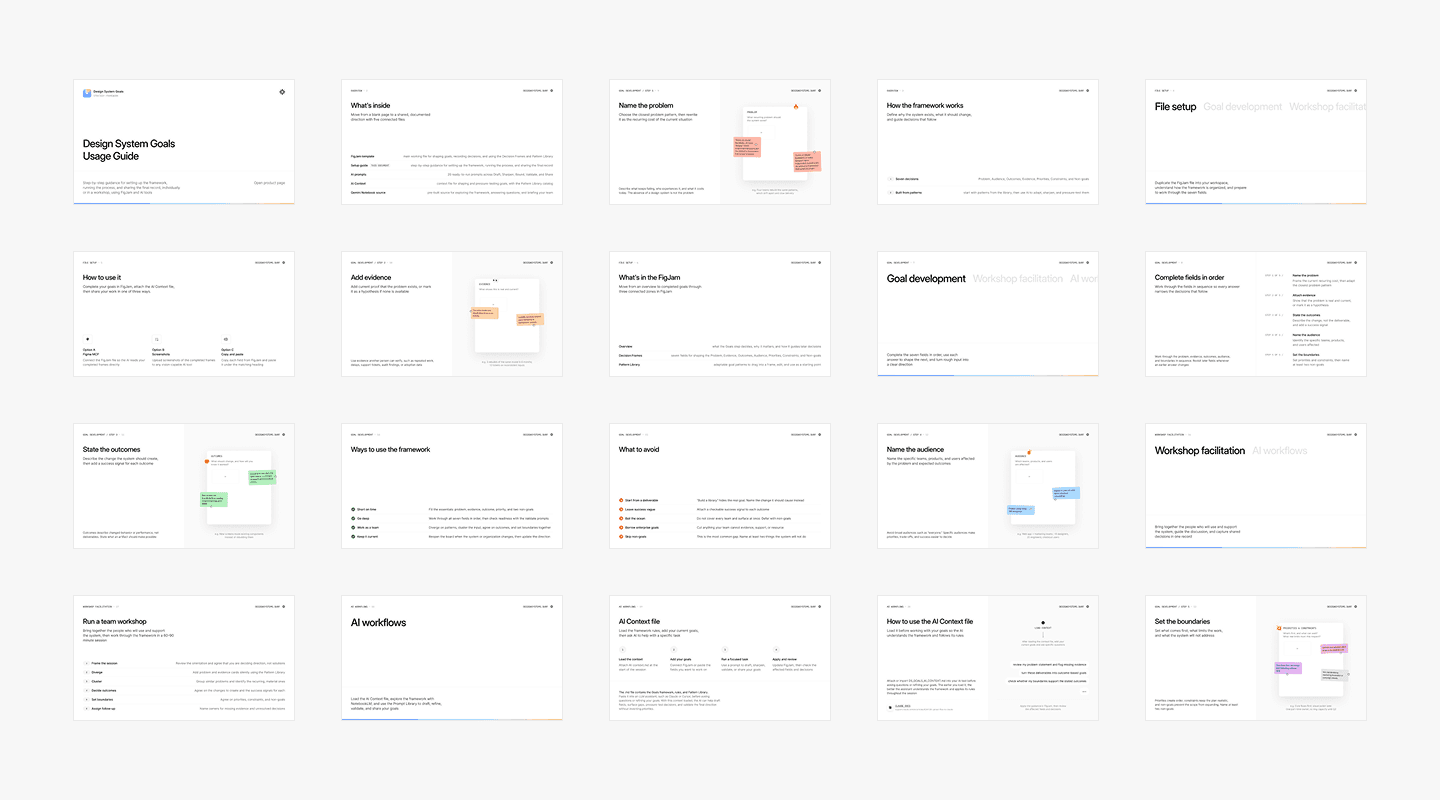
Setup guide
Run the full guided workflow solo or with your team, then compile, review, and share a complete final Goals Record
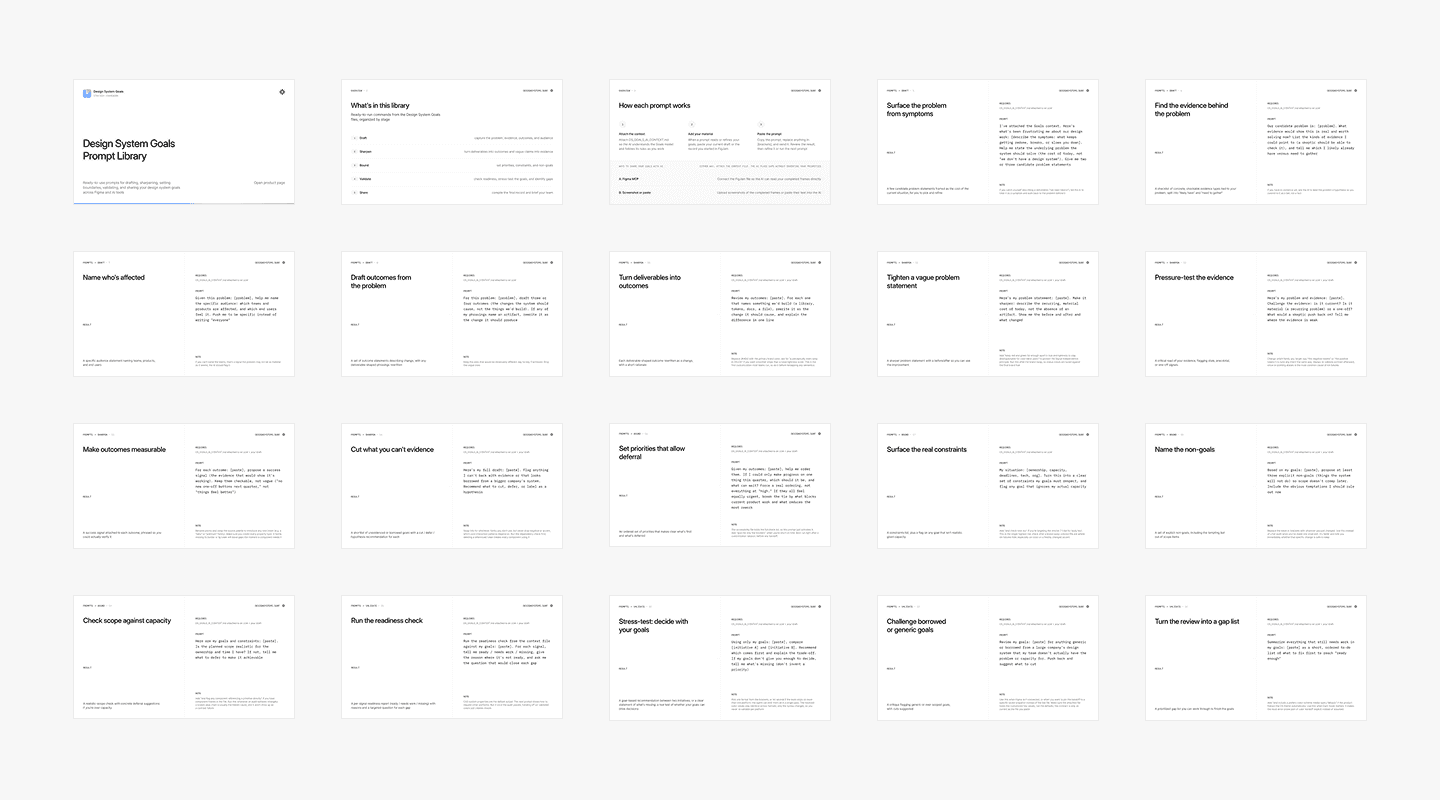
AI prompts
Use 20 guided prompts to move through Draft, Sharpen, Bound, Validate, and Share with clearer, more consistent results
AI context
Md
Give Claude or another LLM the context to draft, sharpen, and validate goals
Gemini Notebook
Md
Ask questions, explore goal patterns, and generate briefings in Gemini Notebook

It gave me a clearer picture of where AI can save time in design-system work while leaving the important decisions and quality checks with the team
Danial Shirali
Product Designer
Use Design System Goals when direction is unclear
Whether you are starting a system, resetting priorities, fixing an existing one, or preparing it for AI
Start a new design system
Before creating tokens, components, and documentation, define why the system is needed, whose problems it should solve, and which outcomes matter most. Use the seven decision fields to establish priorities, constraints, and clear boundaries for the work ahead.
Outcome
You begin with an evidence-backed direction instead of a disconnected list of system assets
Reset goals during a redesign
Repair a messy existing system
Give AI the missing context
Built for teams and designers working on type systems
Use Design System Goals to define, validate, and communicate what the system should achieve before deciding what to build
01
Product designers
Define clear system goals when you own design system work without a dedicated specialist team
02
UX/UI designers
Connect interface decisions to clearer system goals, priorities, constraints, and intended outcomes
03
Freelancers and agencies
Run structured goal-setting sessions and give clients a clear, evidence-backed direction for system work
04
Design system leads
Connect system priorities to product needs, team problems, evidence, and measurable outcomes


























































































Based on analysis of 100+ design systems. Patterns translated into a reusable goals framework
Since 2023, Design Systems Surf has studied how mature design systems define purpose, priorities, scope, principles, ownership, and intended outcomes.
Design System Goals turns recurring patterns from that research into seven connected decision fields, ready-to-adapt formulations, validation prompts, and a clear final Goals Record.


Trusted by designers working on design systems
Feedback from people building, auditing, documenting, and maintaining design systems
10k+
Designers across 175+ countries follow Design Systems Surf for design system examples, patterns, and practical resources
What to know before you start
Clear answers about what Design System Goals includes, how it can be adapted, and how it fits into real design system work
Is this just a FigJam template?
No. The FigJam board is one part of the product. Design System Goals also includes a Pattern Library, AI context .md, Knowledge Base .md, 20 guided prompts, and a Setup Guide.
The board gives you the working decision framework. The supporting files help you draft, sharpen, validate, explain, and share your design system goals with less guesswork.
What is included?
Design System Goals includes a FigJam board with seven connected decision fields, a ready-to-adapt Pattern Library, AI context .md, Knowledge Base .md, Prompt Library, and Setup Guide.
The workflow covers Problem, Evidence, Outcomes, Audience, Priorities, Constraints, and Non-goals. Together, these decisions are compiled into a final Goals Record.
Can I customize it?
Yes. You can adapt every field, pattern, prompt, and final record to your product, team, organization, and current design system situation.
The framework does not prescribe one correct goal. It gives you a structured way to define your own direction while keeping the decisions connected, specific, and grounded in evidence.
Will this fit my design system?
Design System Goals is not tied to one company size, team structure, or level of design system maturity. You can use it before starting a new system or while improving an existing one.
The Pattern Library gives you starting formulations, but every decision should be reviewed and adapted to your product, users, team needs, constraints, and available evidence.
Can I use it with an existing design system?
Yes. You can use Design System Goals to review the assumptions behind an existing system, identify unclear priorities, and define stronger boundaries for future work.
You do not need to replace your current components, tokens, documentation, or roadmap. The Goals Record gives that existing work a clearer purpose and direction.
Can I use it by myself?
Yes. The workflow supports both solo work and collaborative sessions.
You can complete the board independently, use the prompts and AI context to review your decisions, and then share the final Goals Record with designers, developers, stakeholders, or leadership.
Do I need to use AI?
No. You can complete the full workflow manually using the FigJam board, Pattern Library, and Setup Guide.
AI is optional, but the AI context and prompts can help identify weak evidence, vague outcomes, missing constraints, asset-focused goals, and contradictions between the seven decision fields.
What do I get at the end?
You get a completed Goals Record that explains why the design system exists, what problem it should solve, who it serves, what should change, and which boundaries guide the work.
The record can support prioritization, roadmap decisions, stakeholder alignment, team briefings, and AI-assisted workflows. It can also be updated as the product and organization change.
Can I use it for client work?
Yes. You can use the framework to run structured goal-setting sessions, align client stakeholders, and establish a clear direction before starting design system delivery.
The final Goals Record gives the client a reusable decision artifact they can use for planning, prioritization, communication, and future system work.
Still have questions?
Reach out at hey@designsystems.surf

