When does a token library become usable system data?
8 min read
A readable token file can still leave the system open to interpretation. The model must preserve what each value means, how it relates, and where it belongs.

Founder of Design Systems Surf

A team can have tokens in Figma, code, and JSON and still make different decisions from the same library. A designer chooses one blue for a primary action. A developer uses a nearby value for focus treatment. An AI assistant selects the shade that appears most often in existing screens.
Nobody introduces a hardcoded color. Everyone uses approved tokens, yet the system produces different interpretations because the values are reusable while their roles are not.
This is the threshold that matters for an AI-ready design system. Tokens become system data when their structure carries enough meaning for designers, developers, documentation, and AI workflows to recognize the same roles, dependencies, variations, and limits without reconstructing them from appearance or habit.


PRO
A token library can be organized and still remain flat
Tokenization often starts with useful cleanup. Repeated values are collected, named, and placed into a shared library. A palette replaces scattered colors, a radius scale replaces local corner values, and shared shadows replace slightly different effects across components.
The system becomes easier to update, but the values may still sit at one conceptual level. A color library with blue-500, blue-600, and blue-700 is consistent and portable across design and code, yet it does not explain whether those values represent brand expression, interactive emphasis, selected states, or focus treatment.
A designer may remember the distinction, a developer may infer it from component code, and AI may rely on frequency or visual similarity. Each fills the same missing layer differently because the library exposes options without explaining their jobs.
Primitive tokens stabilize shared values, but they do not safely communicate purpose.
The same blue may appear suitable for a button, selected navigation, and a focus ring, even though each use has different requirements around interaction, contrast, and state. Color Foundation connects palette values to semantic roles, surfaces, states, contrast requirements, and controlled modes, so users no longer have to decide what each color is for.


An organized library tells people which values exist. System data also explains which decisions those values are allowed to implement.
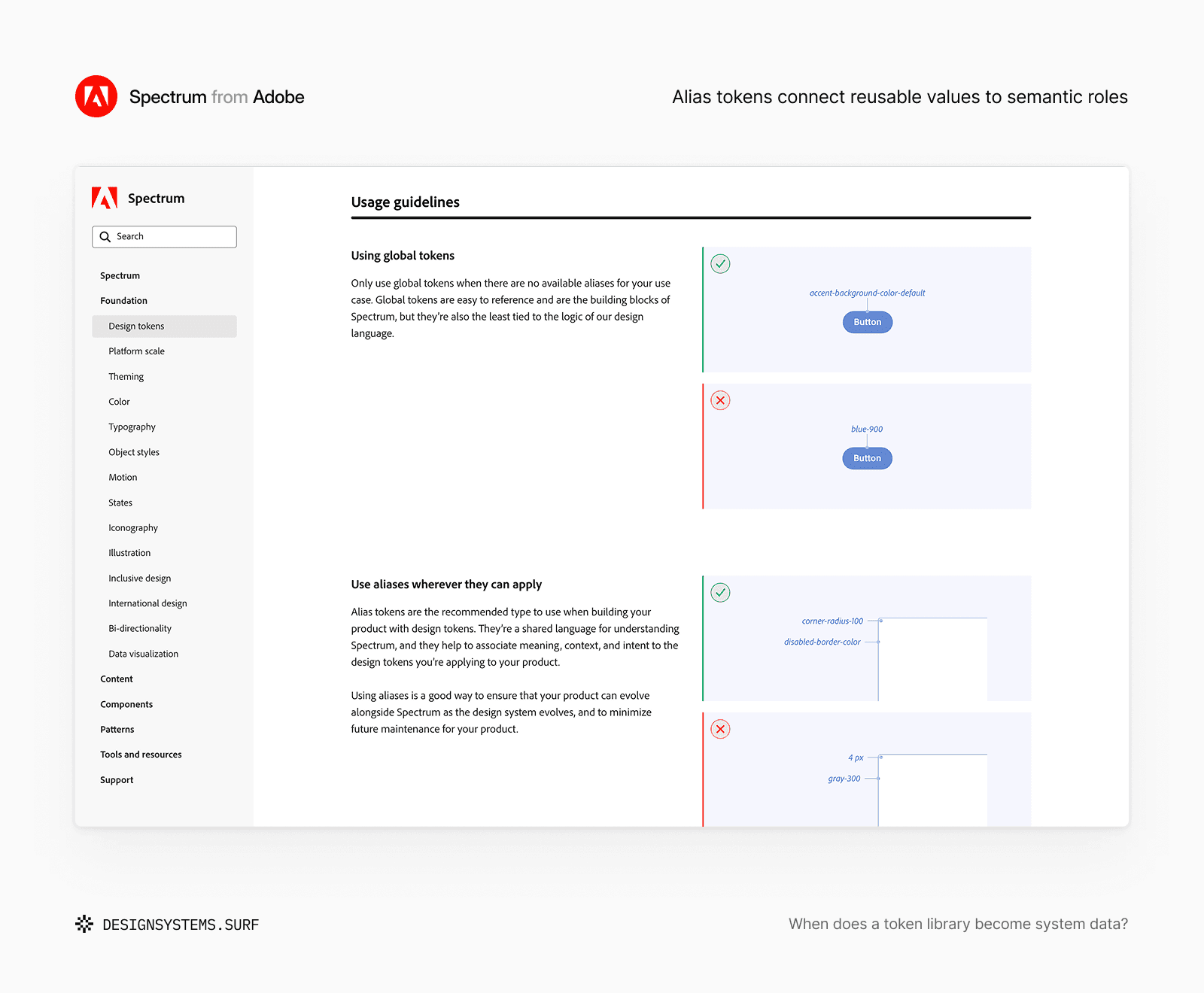
For example, Adobe Spectrum separates global tokens from aliases that describe how those values are used. Global tokens provide the underlying building blocks, while aliases connect them to specific design decisions. The same source value can support different roles without making those roles interchangeable. The model preserves both the available value and the system meaning assigned to it.
The name should survive when the value changes
Names are often treated as labels for finding a token. In a stronger model, they preserve the distinction between a source value and a system role.
Consider an elevation library built around a numbered shadow scale. A token such as shadow-400 identifies a stable source value, but it does not explain whether that shadow belongs to a floating control, temporary menu, or modal surface.
A semantic token such as surface-overlay carries the role that should remain stable when the implementation changes. If the product adopts a flatter visual language, the shadow may become tighter while borders and surface color carry more of the separation. shadow-large would describe the old appearance, while surface-overlay can retain its meaning as the reference changes.
The role survives the implementation. Separating source values from semantic roles keeps the decision stable as its visual expression changes.
A scale is not a role
A clean scale makes values predictable. It does not decide how those values should be used.
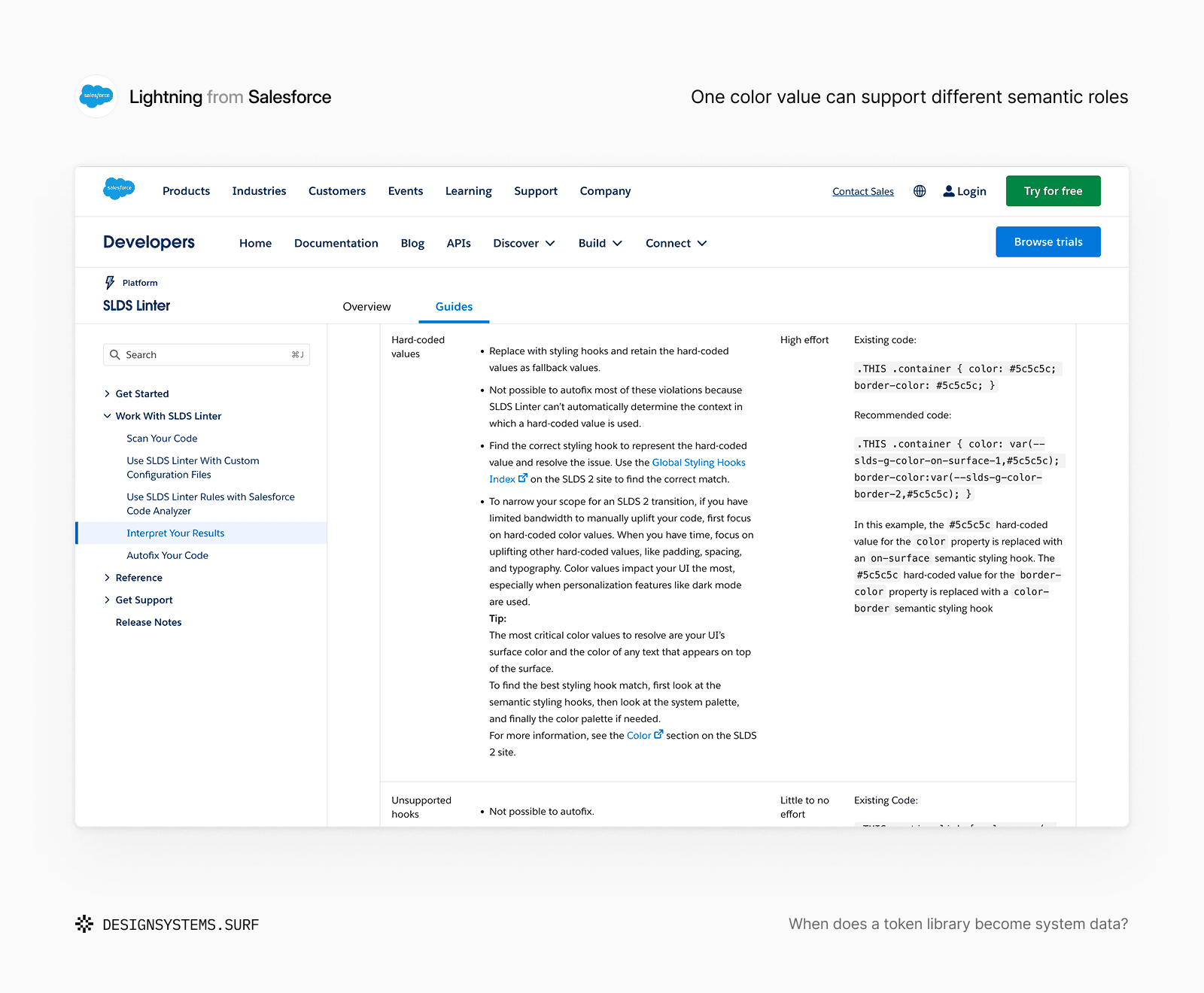
Salesforce shows how one visual value can represent different system roles. In its migration guidance, the same gray becomes an on-surface semantic hook for text and a color-border hook for borders. The value may initially be identical, but property and purpose determine the correct token. Meaning comes from the role, not from the palette position alone.
The same problem appears in radius. A library may contain three carefully selected values, but the scale alone does not explain which shapes belong to controls, containers, nested surfaces, or temporary overlays. Two teams may use the same radius tokens and still create different shape hierarchies because one treats the scale as visual choice while the other treats it as a system of roles.
In Radius Foundation, radius values are connected to shape roles, nested-radius relationships, and product constraints. This allows the system to express why an inner surface may need a smaller radius than its container, or why one product context intentionally uses a tighter shape language.


Not every system needs the same primitive, semantic, and usage layers. A small product may only need a simple separation between source values and roles, while a multi-brand system may need more structure. Extra layers help only when they preserve a real distinction that must survive across products and tools.
Naming should make those distinctions visible. Primitive names can describe position within a stable scale. Semantic names should communicate purpose. More specific usage names should exist only when the system needs to protect a narrower role from being generalized.
This matters to AI because names are often the first explanation of token intent. If a model sees only shadow-400, it must infer why the value belongs in the current interface. If it sees surface-overlay and can follow its reference, the selection can be based on system meaning rather than visual resemblance.
A token change rarely stops at one value
A token system becomes more useful when it shows how decisions depend on one another. Suppose surface-overlay references shadow-400, while surface-floating references shadow-300. These aliases separate semantic roles from their current implementation and make the depth hierarchy explicit.
If shadow-400 changes, the reference path reveals which roles may be affected. Without that relationship, the same value may be repeated across tokens or embedded directly in components. The product can still look consistent, but the system cannot show whether two uses are intentionally connected or only happen to share a value.
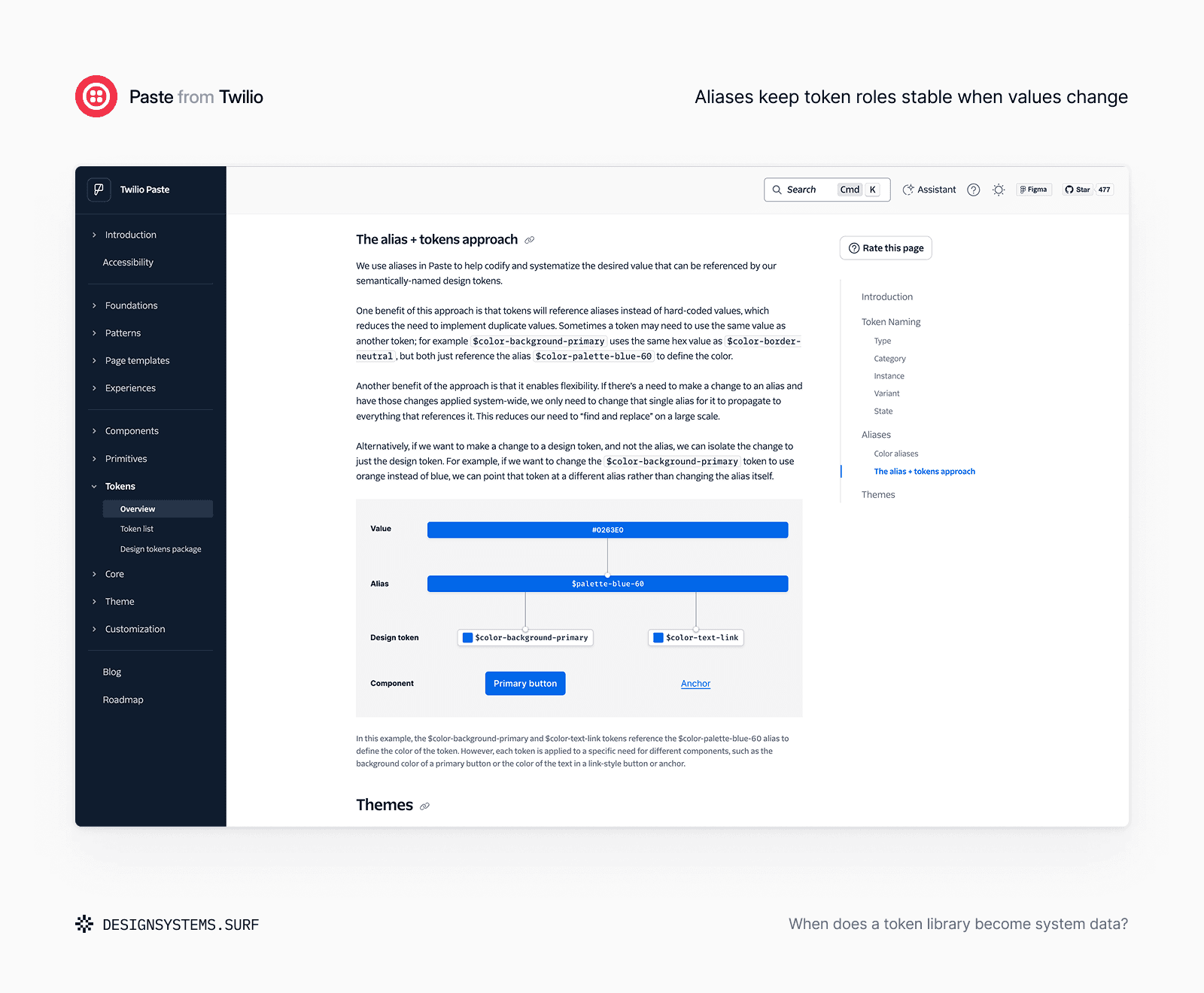
Twilio Paste makes these dependencies visible through aliases. Semantic tokens such as $color-background-primary and $color-text-link can reference the same palette alias while remaining separate system decisions. Components use the semantic tokens rather than the alias directly, so the shared reference records their value relationship while the names preserve their different purposes.
The same logic applies beyond color. An elevation role can reference a shadow value, while a nested radius role can depend on an outer shape decision. In each case, the reference path shows how a higher-level role is expressed and where a change may require review.
References and aliases preserve dependency, not just efficiency. They show which decisions are connected and where a source change may propagate.
Controlled variations should preserve the same semantic roles. In light and dark modes, surface-default may reference different palette values while continuing to represent the same product role. The implementation changes, but design, code, documentation, and AI can still refer to one recognizable decision.
This is what makes change traceable. The model stores not only the current value, but also the roles that depend on it, how they vary by context, and where review may be needed.
AI can read every token and still miss the model
Machine-readable token data can move through tools without being recreated. Names, values, types, references, and modes can be parsed by code, documentation systems, and AI workflows. But a readable file can still describe a system that remains open to interpretation.
An AI assistant may see that action-primary references blue-600 in one mode and blue-400 in another. It can reproduce the reference correctly while misunderstanding when the role applies, how it differs from selected or focus states, and which contrast limits must remain true.
The same problem appears when AI maps a new decision to existing tokens. Without clear usage boundaries, it may select a primitive directly, create a semantic token that overlaps an existing role, or replace an alias with a raw value because the visual result stays the same.
Machine-readable means a tool can parse the data. Machine-understandable means it can apply the same system interpretation the team expects.
Part of that interpretation belongs inside the token model: clear layers, purpose-driven names, explicit references, supported modes, and stable types. Other parts require surrounding context. An AI context .md can explain selection rules and forbidden assumptions. Developer handoff preserves how roles map into implementation, while accessibility guidance carries limits that may not be visible in exported values.
These materials cannot turn a weak value list into a strong system. They help a structured model retain its meaning as it moves between design, code, documentation, and AI-assisted work.
A reliable workflow should be able to select an existing semantic token, explain its reference path, apply the relevant mode, and flag missing coverage instead of silently creating a new value or role. More layers and aliases are useful only when they preserve a distinction the system needs.
When token data carries the system
An AI-ready token system is not defined by the number of tokens it contains or by the fact that they live in JSON. It becomes system data when roles remain clear, relationships stay traceable, variations preserve the same decisions, and missing coverage is visible before another person or tool has to invent the logic.
That is when a token library stops being a reusable list and starts carrying the system with it.

